Litost in southern Bohemia
April 28th 2005
As the train rolled through the hills and hamlets of Bohemia south of Prague, a cheapo-vino-enhanced realization came to. The scene: a rolling patchwork of emerald pines, superimposed randomly upon fields of freshly stacked golden hay, and ramshackle farms, through which babbling rivulets meandered. It simply mesmerized. It wasn’t difficult to imagine the great 19th-century Czech-nationalist composer, Bedruch Smetana, surveying a similar panorama - when he composed the sublime “From Bohemia’s Fields and Meadows.”
Most Americans experience the Czech Republic by way of the obligatory Prague sight seeing whirlwind. Sure it's pretty and fun. However, as the capital accelerates its mimicry of the manicured, Disneyland personas of Munich and Vienna; more and more travelers yearn for a less sanitized experience. That, among much else, was discovered in the hinterlands of Bohemia.
One town blissfully free of blatant corporate commercialization was the regal spa town of Karlovy Vary (Karlsbad). One of the three towns which make up the “spa triangle,” - "Marienbad" and "Franzenbad" are the others - this delightful town is situated in a shallow, shady valley.
Karlovy Vary once distinguished itself as the destination - sorry, Baden Baden - for European royalty and literati, those lovelies in search of curative baths and mineral water. Czech women are attractive too. In fact, even Karl Marx was known to drink deep, imbibe and soak. A well-kept statue testifies as much - even today.
Aside from the traditional 12 springs of medieval lore, a “thirteenth spring” by the name of Karlsbader Becherovka bubbles here - and abundantly. Equally curative, this ambrosial herbal drink packs a good wallop when served ice cold - especially after midnight. Remember Berlin - up on the roof at aurora, anyone?
In the upper reaches of town, fashionable villas aloofly survey coniferous inclines. They’re indifferent to the hustle and bustle of the decidedly less illustrious present day patrons - like us. Perhaps the most delightfully incongruous discovery was an immaculately refurbished Russian Orthodox church. The tightly packed, shimmering gold onion domes cut a striking profile - courtesy of the now long-defunct Yeltsin government - as a prominent plaque always informs. Look: the state did something nice!
Once again among the rest of the plebeians: the riverside colonnaded spas commingled lazily with sundry cafes and restaurants. The most striking one was terraced, affording a most delightful panorama of the pinched quarter. Most establishments reliably serve a delectable assortment of understated, if heavy, Czech dishes - akin to the hearty German kitchen.
For those who cultivate less sedentary pursuits, an obscure trailhead on the outskirts of town leads the hiker on a fabulous 12-mile odyssey - beyond skyward jutting rocks - to dreamy Loket. Here an imposing medieval castle dominates the sky above a placid, jade stream. Set out early, however, lest one be stranded at sunset. That fate required the indulgence of a random Dutch trucker - rather tolerant - of straggling American hitchhikers. Ahh, the good old days. You can find Lady Marion here too.
An hour and a half by car to the south: sleeps the largely industrial city of Plzen or "Pilsen." Pilsner Urquell calls it home - the first source pilsner is what that means. Plzen is also home also to the massive Skoda auto and munitions works. In true Czech form, this means “bad luck.” Given that it was perhaps Hitler’s primary aim in his rotten negotiations at Munich with Chamberlain… The shoe does fit, why not wear it?
A related linguistic aside: the wonderful Czechs are often associated with a kind of laconic fatalism - that's what happens when your country's always been a pawn. In Milan Kundera’s sumptuous story collection, The Book of Laughter and Forgetting, he referenced the corresponding term: litost. It explains things.
Untranslatable directly into English, it simultaneously means: longing, sadness, irony and indifference. We don’t have that in America. We're "winners."
The vicissitudes of history and language aside, Plzen affords the visitor a quaint market square, a smart tower and, as we were to discover, a mythical light emerald elixir for which Hemingway, Baudelaire and Van Gough expressed an affinity.
As appears to be the case generally in Eastern Europe: a seemingly standard dining experience may take a turn to the more than unexpected. In this instance, a garden variety Italian joint morphed into a trendy heavy metal hangout (granted, to “cool” American ears - an “oxy moron”). Suspiciously, it was around that time that 70% alcohol absinth appeared on the digestif card. In short, this delightful, inhibition-exploding fluid constitutes ideal fare for dinner parties or, more to the point, in-law visits. People will wheel tractor tires down a main thoroughfare, if they aren't sufficiently judicious.
The ingestion of faux-opiates aside, most anyone venturing into the Czech provinces will likely be confronted by more than a piddling dose of “reality.” Now, most Americans “travel” to escape, but for those who don’t do that - roll up southward out of Dresden on the A99.
Here the rubber of fuzzy nostrums regarding “economic reform” hit the cobblestones of real existing capitalism. In those days - things are doubtless better now - the main artery between Berlin and Prague hosts the longest promenade of prostitutes in the world. Czech women shiver and shake in sub-zero temperatures for miles on end. Wishing they didn't have to look for and hook for the next Johann, or John - as the case may be.
Injecting a bit of retro communist history into this already surreal melee were Vietnamese refugees from back in the day. They eke out a meager existence hawking kitschy souvenirs, discount beer and a cornucopia of cheap cigarettes. The scene amounted to an utterly absurd free trade zone, where the newly integrated 1st World meets the freshly demoted 3rd. They're just lucky to be out of the wreckage left. A word of assurance for the faint of heart: reliable, affordable rail service connects most every destination of note, in the event that dicey border crossings don’t pique the curiosity. They pique the stomach - for sures.
During this foray into the former Sudetenland, Most, the capital of the brown coal district, clearly illustrated the legacy of Soviet-mandated environmental megalomania. During its productive heyday, a goodly chunk of town was razed and the church moved, so that a particularly rich vein could be exploited. State socialism v. state capitalism - well, there are some differences.
The attendant noxious power plants, which pock the plain at the foot of the Ore Mountains, belch their filth. The result? Gasping patches of dying forests. Conversely, there is no alternative fuel of equal abundance and "price-effectiveness" to heat homes and power industry. In the dimming of evening, most vivid were the gargantuan strip mines. Leviathan cranes toiled in the endless pitch. Sidewinders on rails emerged from the maw - sluggishly hauling their bounty.
Once sated by incidental, touristy environmental degradation, a search for earthy Bohemian eats ensued - some solace in a solitary village. Here the standard Eastern European stray cigarette smoke is compensated for by furrowed faces and a dank ambiance which set the tone for fried flesh cutlets with potato pancakes. A delight.
Some 50 kilometers to the southwest lay ostensibly unremarkable Terezin, known to the world as Theresienstadt. During the Second World War, the Nazis used this Austro-Hungarian Empire-era fortress near town as a “transit camp” for their “deportees” - the ones awaiting “special treatment” and “resettlement in the East.”
If this bit of hubris-ridden bureaucratese wasn’t sufficient, in 1942, as news of atrocities began to reach the supine - no way, the word is uncaring - West, the Nazis produced a film here for Red Cross consumption. Depicted were: happy Jews watering their gardens, watching their playing children. You shouldn't watch it. It makes you yearn for death yourself.
While not an extermination center on the order of Auschwitz or Treblinka, nearly 60 years later, the icy gales faintly recalled the suffering that once whipped through sterile barracks and barren parade grounds. In a further reminder of the indignities that now-gone century has visited upon the Czechs: the nearby site of Lidice. It's not a town anymore. The entire populace of 2,000 was murdered and the town razed when the assassins of Final Solution King Pin, SS General Reinhard Heydrich, allegedly sought refuge there.
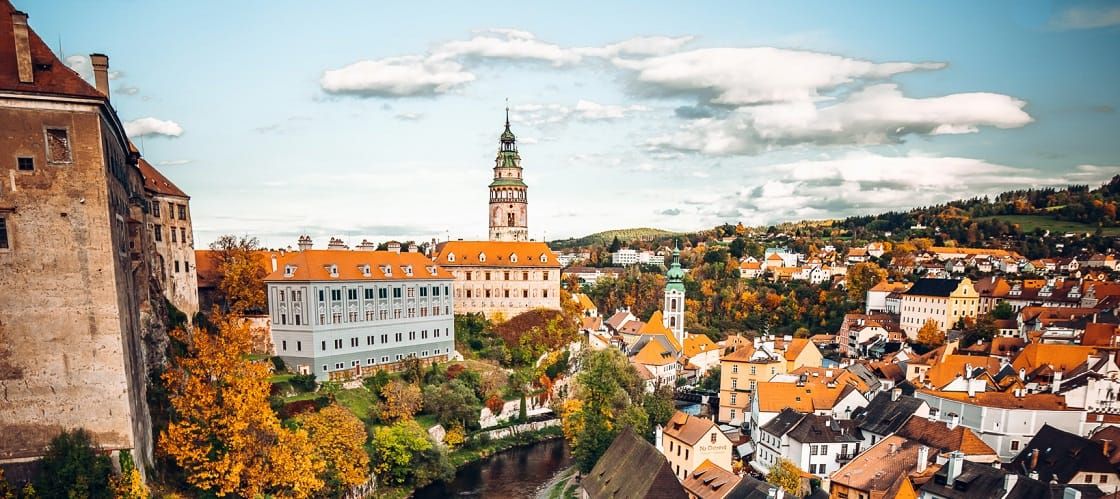
Shooting a line at once equidistant from Prague and the Austrian border, the magical realm of southern Bohemia was soon approached. UNESCO - they of the black helicopter fleet - saw fit to declare Ceske Krumlov a world historic treasure, a distinction with which no sane human would quibble.
Perched partially astride the folds of another serpentine river, the ambiance spreads outward to haphazard, nearby hills. Ceske Krumlov is a medieval fairy tale. Here a mighty fortress-cathedral complex hangs on a sheer cliff - below lie expressionist streets and contrasting churches peeking above the din.
Having devoured delectable trout, the procession led upward, past several disinterested bears. They were guarding the entrance from their pit. A curious mosaic adorns the tower, inviting visitors to climb its creaking stairs to the finest vista in town. Luminaries, who graced Ceske Krumlov, include one Egon Schiele.
He was an early 20th-Century decadence master, known for his simultaneously alluring yet vaguely disturbing representations of the female form. Then you see how he painted himself. Tortured artist - a redundancy. This paragon of painted alienation made certain expose himself as a disturbed miscreant - any such tendencies would have gestated in Vienna, not here. Nietzsche attempted to combat decadence, correctly.
A convenient home base - and beautiful town in its own right - is Ceske Budjovice, (Budvar) home of the original, and decidedly superior, “Budweiser.”
[Saw a house proud town mouse Bud ad recently - it said that this Amurican-owned brew hole creates "the best beer in the world." Kinda like the greatest democracy in the world, huh?]
Home to one of the Czech Republic’s finest squares, this city, this town is situated a mere 70 kilometers from Austria. This fact is made all-too-clear by the plodding German one hears everywhere.
[They can buy cheap stuff there! Kind like in "TJ" for So-Cals.]
It offers an ornate fountain, massive promenade, a pastel-purple, thrice pronged church and the traditional massive tower.
Embellishing the already heady aesthetics, Ceske Budjovice also appears to have promulgated a well-adhered-to town ordinance. It would appear to mandate that most every young woman wear a mini-skirt.
That said, yet again, invitations from the friendly son of the lady with whom you are staying - to frequent a “dance club” or “nite club” - should be approached with some circumspection. One might just find oneself in a brothel like “Lady Marion.” Paying - in Deutschmarks, of course - for a very expensive drink. Clearly unamused, monolingual security goons will see to that. One friend was very nearly “pummeled by a Czech pimp.” Always be close to the door - that way you end up getting over the ten-foot-high metal gate - scot free. Fun.
Unsurprisingly, destinations in the Czech Republic, which both tour groups and most backpackers miss, apprise one of the actual character of this country. After all, New York, San Francisco, Fuckin' Vegas and Suckin' Disneyland don’t represent America - too much, come to think of it for a second. So, for those huddled masses, yearning to breath the rarefied air of the Czech provinces, make your reservations soon, before McDonalds, WalMart and the Gap beat you to that punch too.